Switched EQ Explained: Mixing With Fixed Frequencies
What a switched-frequency EQ does, why its dial numbers are labels and not centre frequencies, and a three-move workflow. Shown on the free Ferrule 51.
A fully parametric equalizer lets you place a band at any frequency, with any width, at any gain. A switched equalizer does the opposite. Each band offers a handful of fixed frequencies on a rotary switch, the width is decided for you, and the only free control is gain.
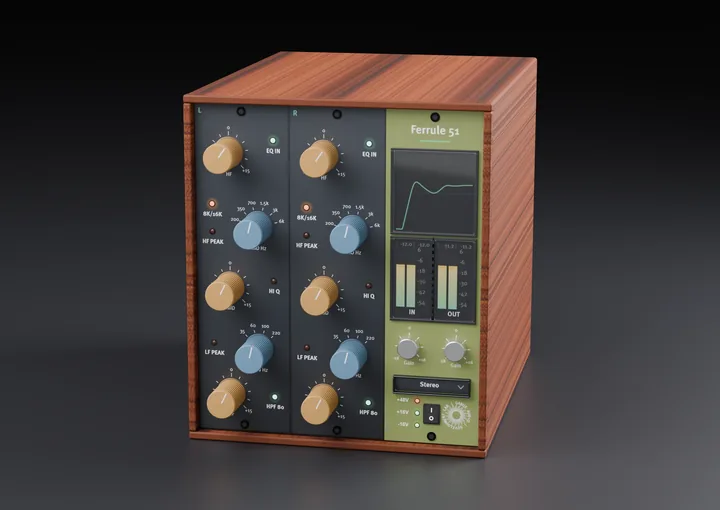
That sounds like a limitation, and it is one. It is also why this kind of EQ is quick to work with. This article explains what a switched EQ actually does, what the numbers on its dials mean, and how to work with one. The examples use Ferrule 51, our free three-band inductor-style equalizer.
What "switched" means
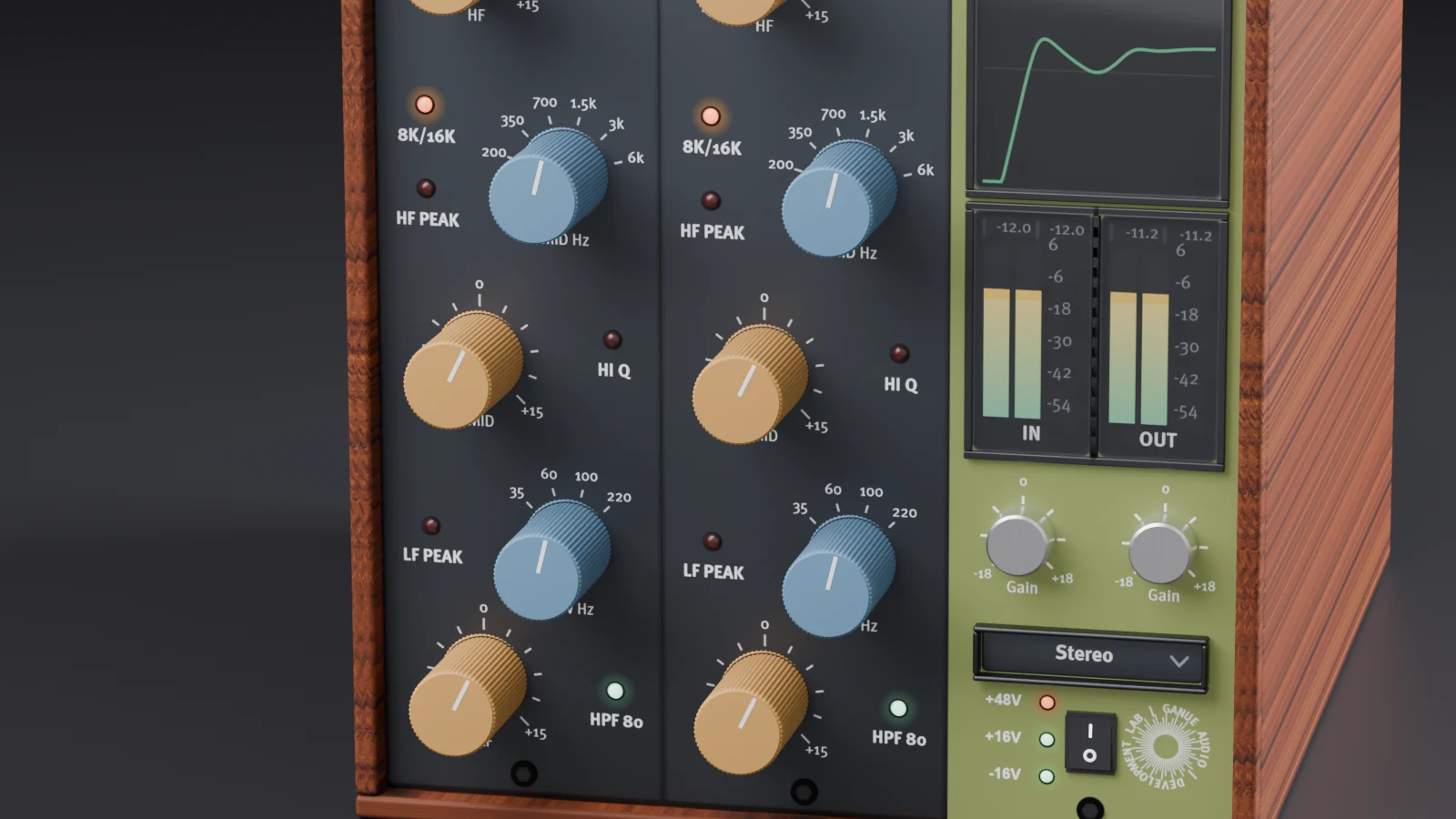
On Ferrule 51 the three bands look like this:
| Band | Type | Frequency choices | Gain |
|---|---|---|---|
| HF | shelf or peak | 8K, 16K | +/-15 dB |
| MID | peak, optional HI Q | 200, 350, 700, 1.5k, 3k, 6k | +/-15 dB |
| LF | shelf or peak | 35, 60, 100, 220 | +/-15 dB |
There is also a fixed 80 Hz high-pass filter, in or out.
That is 2, 6 and 4 positions: twelve places a band can sit. There are no frequencies in between. The MID knob is not a sweep; it steps from one position to the next.
Why fewer choices can be faster
The decision gets smaller. With a sweepable band you make three decisions at once: where, how wide and how much. With a switch you make one small choice (which of six) and then turn the gain. Usually some of the six are plainly wrong for the source, so the real choice is between two or three.
The positions work as a set. The steps are roughly an octave apart. You are choosing between regions such as "low mids" and "presence", not between 2.9 kHz and 3.1 kHz.
Broad curves are hard to misuse. The bands on this kind of EQ are wide. On Ferrule 51 the MID band at a +6 dB boost has a Q between 0.54 and 1.03, depending on the position. A band that wide changes tone. It does not ring or isolate a single note, so a move of a few dB rarely sounds like "EQ".
The numbers on the dial are labels
This is the part that surprises people. On an inductor-style EQ the engraved numbers follow the traditional markings for this kind of circuit. They name a position. They are not a promise that the curve peaks exactly there.
The Ferrule 51 manual lists what every position does. For the MID band at a +6 dB boost:
| Dial marking | Where the curve peaks | Q (half-gain) |
|---|---|---|
| 200 | 215.5 Hz | 0.54 |
| 350 | 383.3 Hz | 0.60 |
| 700 | 846.9 Hz | 0.76 |
| 1.5k | 1696.4 Hz | 0.68 |
| 3k | 3441.0 Hz | 0.81 |
| 6k | 7186.5 Hz | 1.03 |
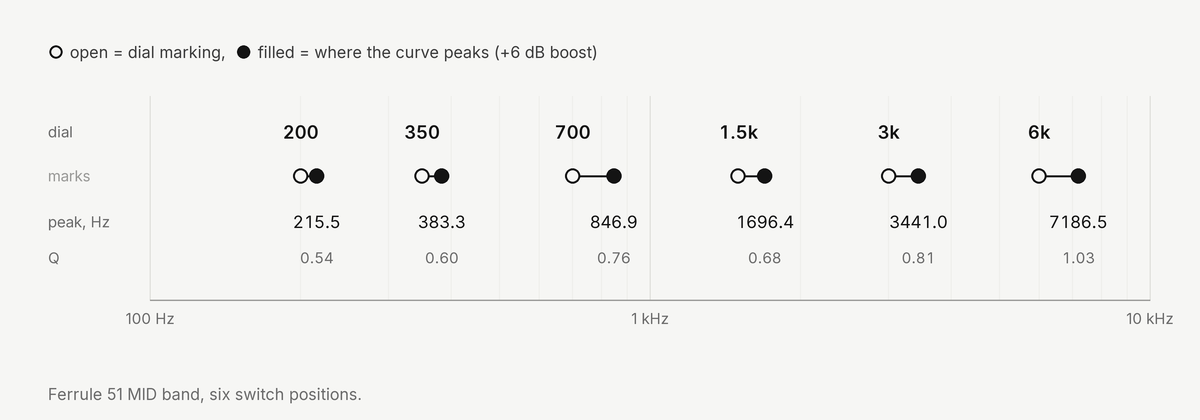
The peak sits above the marking at every position, by about 8 to 21 percent. A few more behaviours come with the circuit style, and all of them are in the manual:
- The gain knob does not land exactly on its mark. At the +15 mark the MID and LF bands reach about +16 to +17 dB; at +6 they reach about +5 to +5.6 dB. The HF shelf is still rising at 20 kHz, where the +15 mark reads about +19 to +21 dB. The readout shows the gain the band actually reaches, not the knob position.
- A shelf boost leaves a small dip in the mids. With the LF shelf at +6 dB the dip is between -0.35 and -0.45 dB, somewhere between about 450 and 950 Hz depending on the position.
- Boosts and cuts are not mirror images. On the MID band, a boost keeps about the same width as the gain rises. A cut gets narrower as it gets deeper.
- The LF 220 position is not a shelf "at 220 Hz". At full boost it holds full gain only up to about 124 Hz and reaches about 70 percent of the boost at the marked frequency.
- The high-pass has a small lift above its corner. Its -3 dB point is 75.5 Hz, and it rises by 1.74 dB at 126 Hz before turning down.
None of this needs to be memorised. The practical point is: choose positions by ear, and read the screen or the manual if you need the exact figure.
A three-move workflow
This works on most sources and takes three moves.
- Clear the bottom. Switch the high-pass in on sources with nothing you need below about 80 Hz, and listen: it also lifts about 1.7 dB around 126 Hz. It is fixed, so there is nothing to tune.
- Find the one mid position that matters. Set MID to about +4 dB and step through the six positions while the track plays in the mix. One position will make the source clearer, or one will make its problem obvious. Stop there. Then decide the direction: boost what helps, or cut what hurts, and set the amount.
- Finish with one shelf. Add either low weight or top air, not both by reflex. On Ferrule 51 the HF shelf keeps rising to 20 kHz, so the 16K position reads as air and the 8K position reaches further down into the presence range.
Then compare with EQ IN off at matched loudness. On Ferrule 51, EQ IN off returns the samples untouched for the three bands.
Where a switched EQ is the wrong tool
- Narrow problems. A resonance at one note, hum, or a whistle needs a narrow band you can place exactly. Twelve broad positions cannot do that.
- Matching a specific frequency. If a reference says "cut 2.4 kHz", there is no 2.4 kHz. The nearest positions are 1.5k and 3k, and their real peaks are near 1.7 and 3.4 kHz.
- Above 20 kHz. Ferrule 51's response above the audible band is not level. With every band at 0 dB it dips at 88.2 kHz and higher, by up to 6.1 dB at 88.2 kHz and 10.5 dB at 96 kHz. With a band boosted it can rise at some settings: by up to +33 dB at 44.1 and 48 kHz, and more at higher rates. Within 20 kHz the response is as documented. The manual gives the figures per sample rate.
Ferrule 51 also adds a soft level-dependent stage when EQ IN is on. It is transparent at or below about -13 dBFS at its input, its peak third harmonic is about -65 dBc, and it does not compress. If you want an EQ with no colour of its own at all, this is not that.
Same idea, different sets of positions
A switched EQ is defined by its set of positions, so different designs suit different jobs. The Ferrule family has four more, each a one-slot module:
| Plug-in | Bands and positions |
|---|---|
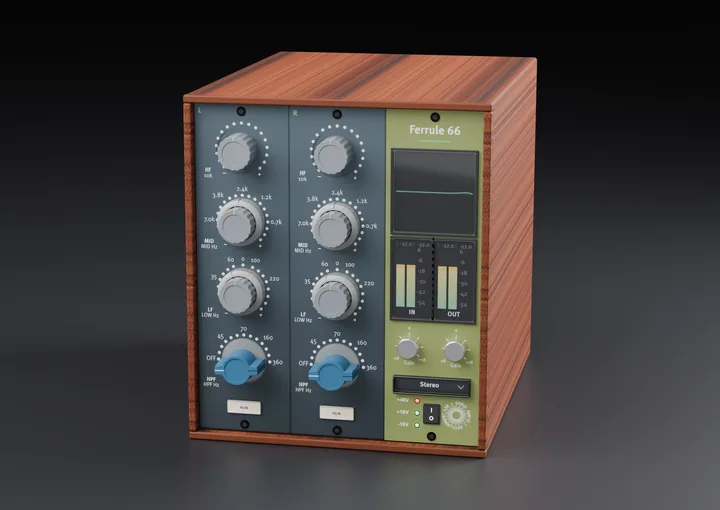
| Ferrule 66 | HF fixed at 10k; MID 5 positions; LF 4; 5-position high-pass |
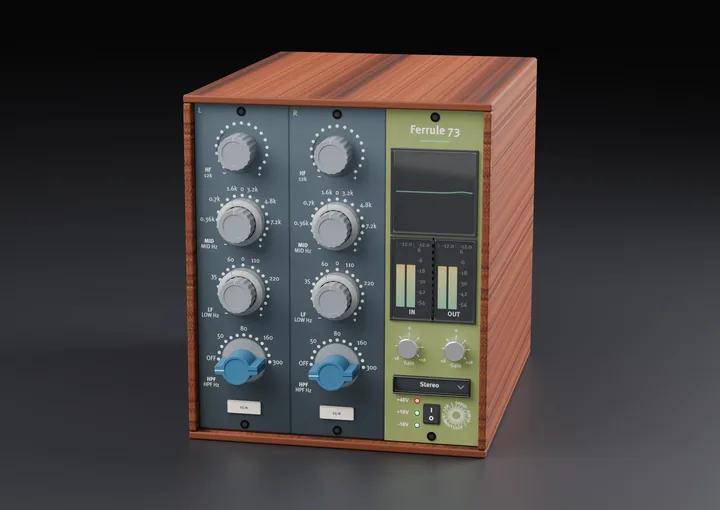
| Ferrule 73 | HF fixed at 12k; MID 6 positions; LF 4 with a resonant low shelf; 5-position high-pass |
| Ferrule 81 | Four bands: HF 5, HI-MID 10, LO-MID 10, LF 5, each plus OFF; high-pass and low-pass, 6 positions each |
| Ferrule 84 | HF 3 positions plus OFF; MID 6 with HI Q; LF 4; high-pass 5 and low-pass 6 positions |
Each of the four is USD 19 until Nov 30, 2026, then USD 29, and each has its own 14-day trial with every feature. The Ferrule Vintage Collection (Ferrule Pre plus these four) is USD 49 until Nov 30, 2026, then USD 69.
Read next: Oversampling in Plug-Ins: What It Fixes, What It Costs