
Ferrule 51
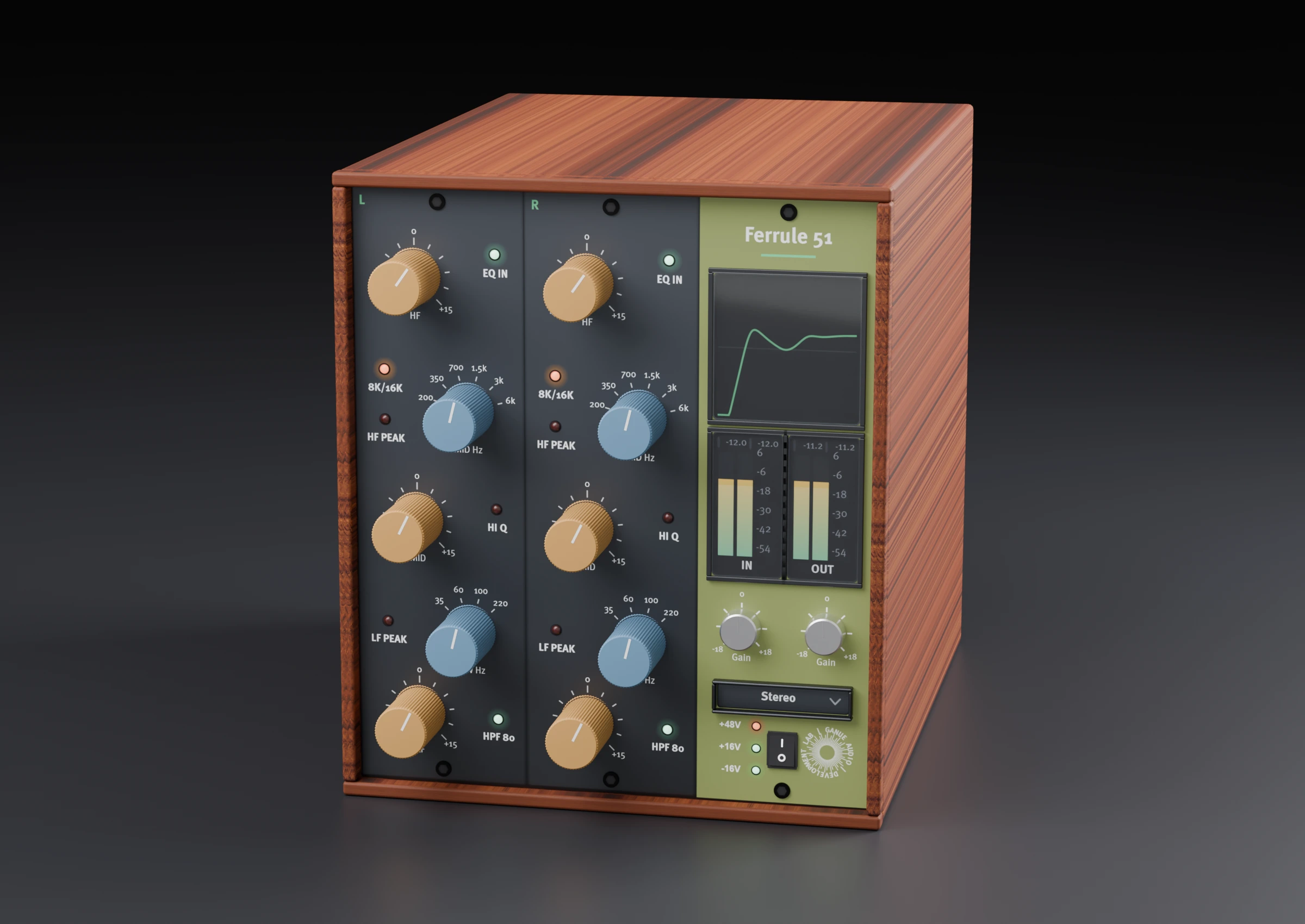
Ferrule 51 is a three-band inductor-style equalizer with a fixed 80 Hz high-pass filter. Its curves were measured at every switch position and gain step, then rebuilt from original code, and a soft level-dependent stage sits inside EQ IN. It runs as a mono or stereo plug-in (Stereo, Dual Mono, M/S). It is free: no trial, no licence file, no activation.
The facts, in numbers
| Bands | 3 (HF, MID, LF), +/-15 dB, plus a fixed 80 Hz HPF |
|---|---|
| Level-dependent stage | Soft, odd-order, inside EQ IN. Transparent below about -13 dBFS at its input; peak third harmonic about -65 dBc; it does not compress |
| Oversampling | Off / 2x / 4x / 8x; default 4x realtime and offline. It wraps the level-dependent stage only, so it never changes the EQ curve |
| Latency | 0 samples with oversampling Off; 3 / 4 / 5 at 2x / 4x / 8x (default 4x: 4 samples) |
| Presets | 35 factory presets. Init plus 34 starting points: vocals, drums, bass, guitar, keys, buses, colour and utility. |
| Stereo | Mono or stereo instance; Stereo (linked), Dual Mono, M/S |
| Sample rates | 44.1-384 kHz, designed coefficients at each of eight rates, so the response in Hz is the same at every one |
| DC | Blocked inside EQ IN (first-order, 2 Hz; -0.04 dB at 20 Hz; DC down by more than 138 dB). With EQ IN out, DC passes |
| Bypass | Click-free: the power switch crossfades over about 15 ms, with the dry path delay-matched |
Every control on the strip
Every frequency control is a switch, so every position you can select is a position that was measured. Ctrl / Cmd while dragging moves a gain knob in exact 0.1 dB steps.
| EQ IN | Puts HF, MID and LF in and out per strip. Out is bit-transparent; the HPF is not affected. |
|---|---|
| HF | +/-15 dB shelf or peak. Corner switch 8K / 16K, PEAK switch. |
| MID | +/-15 dB peaking band. Six frequencies: 200, 350, 700 Hz, 1.5k, 3k, 6k. HI Q narrows the band. |
| LF | +/-15 dB shelf or peak. Four frequencies: 35, 60, 100, 220 Hz. PEAK switch. |
| HPF | Fixed 80 Hz, second order, in or out. It sits ahead of the EQ and is independent of EQ IN. |
| General section | Analyzer screen (Curve, FFT, Phase), IN / OUT meters and trims, stereo-mode selector, power switch. UI size 75-200% |
What is not perfect, plainly
We ship disclosure, not marketing. These are the known limits of Ferrule 51 1.0.0; the manual carries the full list, and the Ferrule FAQ answers the common questions.
- The reported latency is nominal (manual section 9.1): with oversampling on, the measured group delay runs up to about 0.8 samples longer than the reported figure; with oversampling Off the reported 0 matches the measurement at 44.1, 48 and 96 kHz.
- Group delay of the oversampling filters is not constant (manual section 9.2).
- Sample rates other than 44.1, 48, 88.2, 96, 176.4, 192, 352.8 and 384 kHz -- no host offers one -- are answered with the nearest designed set, which is an approximation and not a designed response.
- Not measured for this manual: playback in every host on every platform. The primary verification host is Studio One, and Logic on macOS. Every figure here is a reading of the Windows build; none was measured on macOS. Pro Tools (AAX): when this manual was written the AAX build had not yet been tried by hand in Pro Tools itself; the release procedure runs Avid's AAX validator on the signed build before it is published.
- Level-dependent stage: transparent (bit for bit) at or below -13 dBFS at the stage's input -- the worst case, which is low-frequency material; above 2 kHz about -6.4 dBFS. Its peak third harmonic is about -65 dBc and it does not compress (the fundamental moves less than 0.04 dB from 0 to +24 dBFS).
- Fast gain moves (a jump of more than 2.5 dB in one step from a knob resting for 30 ms: a preset, a typed value, an automation jump) are brought in over about 30 ms instead of sweeping the filter through the jump. In the LF band at high gain (35 to 100 Hz) the last 0.1 dB can take up to about 75 ms. None of this adds latency. Not measured: 88.2, 176.4, 352.8 and 384 kHz for these transitions.
- Sample-rate behaviour is by design. Ferrule 51 holds the shape in Hz at every supported rate (manual section 11); the response does not move with the session's sample rate.
- Above 20 kHz the response is not level. With every band at 0 dB (EQ IN), at 44.1 and 48 kHz the response from 20 kHz to the top of the band stays within -0.40 / +0.10 dB of its level at 20 kHz (the EQ curve; with oversampling on the top of the band falls further, section 9.2). At 88.2 kHz and above it does not: depending on the switch positions it dips by up to 6.1 dB (88.2 kHz), 10.5 dB (96 kHz), 17.8 dB (176.4 kHz), 13.0 dB (192 kHz) and 12.8 dB (352.8 / 384 kHz) between 20 kHz and the top of the band, and rises by up to 2.4 dB (192 kHz). At the default switch positions the dip is 7.7 dB at 45 kHz (96 kHz) and 10.4 dB at 81 kHz (176.4 kHz). The reference unit is level there; we tried two designs that are, and both made fast gain moves at those rates less clean, so this version keeps the dips. Within 20 kHz the response is the one described in section 11.
- Above 20 kHz with a band boosted or cut, at some settings the response rises well above the audible band's level. With a band away from 0 dB the response above 20 kHz is not limited at every setting: on 933 of the 14,888 band settings we design (and positions between them) it rises more than 3 dB above the larger of its 20 kHz level and 0 dB. The largest gain above 20 kHz of any designed setting, by rate: 44.1 / 48 kHz +33 dB (HF 8k peak); 88.2 kHz +66 dB (HF 16k shelf); 96 kHz +36 dB (HF 8k peak); 176.4 kHz +58 dB (HF 8k peak); 192 kHz +37 dB (HF 8k peak); 352.8 kHz +71 dB and 384 kHz +67 dB (HF 16k shelf). The MID band reaches +12 to +32 dB above 20 kHz at 88.2 kHz and above, and the LF band +21 dB at 192 kHz (LF 220 peak). Positions between the designed settings can read a little more. Within 20 kHz the response is the one described in section 11.
- A preset load is one step. A factory preset, a user preset, Reset to Init and a restored session each write every parameter they set once, straight to its final value, and the audio engine takes the whole set up at a single buffer boundary, so no buffer plays a half-loaded mix of the old and new settings. Host automation that arrives while a load is being applied is taken up as soon as the load ends (a few milliseconds).
- The level just after a preset load. In a test with steady tones (every factory preset loaded over Init and over its neighbours in the list, both directions; 606 combinations of load, tone and oversampling setting) no load rose more than 0.71 dB above the settled level, in any of those combinations.
- A switch that changes the latency (the oversampling mode or phase and, where this product has them, the Bloom engine, Flutter or Look) fades the output out over 5 ms, holds silence and fades it back in over 5 ms. For an oversampling change the whole mute lasts about 21 ms into minimum phase or Off and about 22 to 24 ms into linear phase at 44.1 and 48 kHz, about 18 and 19 ms at 96 kHz. If the IN trim was moved within the last 50 ms, the silence lasts until that move has finished (up to about 50 ms longer). In a test of such switches on every Ferrule product the largest sample-to-sample step on a 40 Hz tone read at most 1.086 times the signal's own (the line is 1.10). Content below 24 Hz inside the mute is not covered by that reading.
- At 192 kHz with a 16-sample buffer the one buffer in which an oversampling-mode change swaps the oversampling chain takes longer than the buffer's period (a possible dropout at that moment on a host that cannot absorb it; the output is muted by the fade there). Measured on Ferrule Pre: Off to 8x linear 355 percent of the period, the worst other pair 341 percent, the smallest pairs 170 to 177 percent. The code is shared; the other products were not read on this.
- The IN and OUT trims glide in dB over 50 ms, with no corner at either end: a move that is reversed halfway turns from where it is, and a move never passes its target. Moving IN and OUT in opposite directions at the same moment does not bump the level. In a test of single trim moves (60 Hz, 900 Hz and 8 kHz tones) the largest change of slope read at most 1.02 times the signal's own on every Ferrule product (the line is 1.10); a switch that changes the latency, made inside an IN move, adds no dip of its own.
- Band gain and IN trim automated together. When a band gain and the IN trim are automated together in a ramp, the small level wobble during the move can differ with the host's buffer size (the plug-in reacts once per buffer, so a smaller buffer gives more, smaller steps). The largest difference is at most 0.75 dB, against up to 1.92 dB in a plain design in which the band gain and the IN trim glide separately, but a few individual cases differ more than in that plain design (the worst, a low-frequency band over a 100 ms ramp at 48 kHz, 0.60 dB against 0.04 dB).
- IN trim reversing during a combined band and IN move. When the IN trim reverses during a combined band and IN move (or the two move by different amounts), the level can briefly swell or dip a little more than the ideal path: at most 0.52 dB over the larger of the ideal path and a plain design in which the band gain and the IN trim glide separately, in 25 measured cases. On the MID bell this happens only away from the centre frequency; on the LF and HF shelves it also reaches the low LF test tone.
- Host bypass and re-engaging. At minimum-phase oversampling (host rate below 150 kHz) the crossfades between the dry and the processed signal match the dry path's phase while blending. The price is a brief high-frequency dip: for this product up to -0.93 dB at 20 kHz at 44.1 kHz and about -0.58 dB at 48 kHz at 4x and 8x. Linear phase, oversampling Off and rates of 150 kHz and up are not matched.
- A parameter change made while the stereo mode is handing over is heard only from the end of the hand-over ramp (measured on Ferrule Pre: up to 110 to 119 ms at 48 kHz with 8x oversampling, 467 to 476 ms at 192 kHz; the code is shared, this product's own figures were not read).
Formats & requirements
| Developer | GANUE Audio |
|---|---|
| Version | 1.0.0 |
| Windows | Windows 10 or later (64-bit): VST3, AAX |
| macOS | macOS 11.0 or later: VST3, AU, AAX (one Universal build, Apple Silicon and Intel; signed and notarized) |
| Standalone | None |
| Licence | None needed: free, no licence file, no iLok, no account, no online activation (free-use terms) |
| Trial | None: it is free |
| Price | Free. Also in the Ferrule Modern Collection and the Ferrule Complete Collection |
| SHA-256, Windows installer | eed7dd6180353a8ef32c9aeb76df4a08dffb850aa6891bbee1642f7b0be2843f |
| SHA-256, macOS installer | deefa27f5acd0c60c013f51c70a7b8b20ec3db4081961ac116445b8091467936 |
Get Ferrule 51
Free. No licence, no trial, no iLok. Windows & macOS.
The download is a Gumroad page at price 0 with both installers (Windows .exe, macOS .pkg); Gumroad may ask for an email address to deliver the files. The installer includes the PDF manual.
The Windows installer is not yet Authenticode-signed. If SmartScreen appears, choose "More info", then "Run anyway". SHA-256 of the Windows installer: eed7dd6180353a8ef32c9aeb76df4a08dffb850aa6891bbee1642f7b0be2843f (79,657,941 bytes). The macOS package is signed with a Developer ID and notarized by Apple. SHA-256 of the macOS package: deefa27f5acd0c60c013f51c70a7b8b20ec3db4081961ac116445b8091467936 (242,965,315 bytes). All checksums: checksums page.
Also in the Ferrule Modern Collection and the Ferrule Complete Collection.
Ferrule 51 is licensed under the End User License Agreement for free products.