
Ferrule Pre
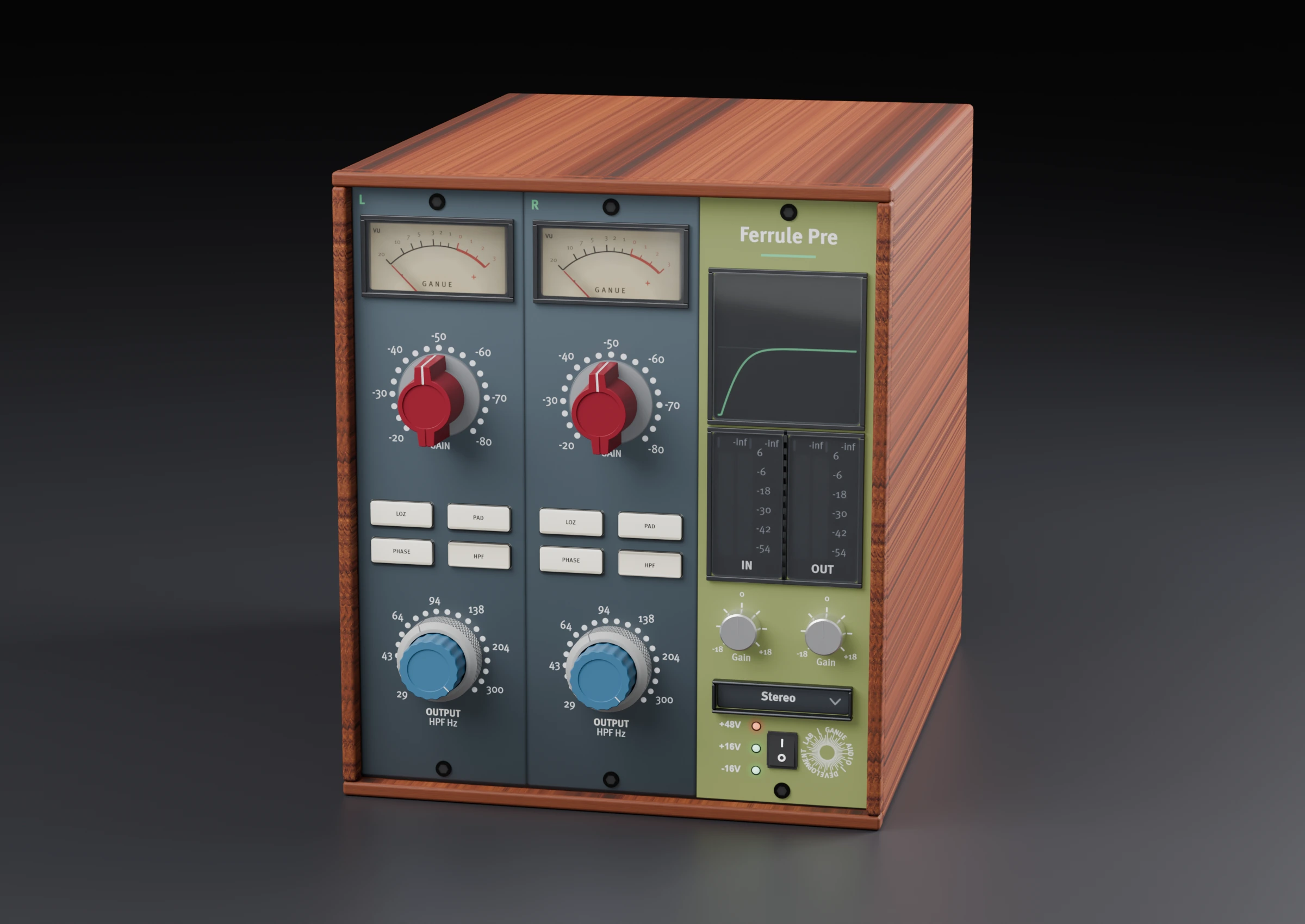
Ferrule Pre is a free microphone and line preamplifier from GANUE Audio. It has a continuous GAIN control (no OFF; up to more than +80 dB reached), LOZ, a -20 dB PAD, polarity, a high-pass filter and an output attenuator, in Stereo, Dual Mono or Mid-Side. The level stays put as you turn GAIN, and the low end stays full when the stage is driven. There is no trial, no licence file and no activation: it is simply free.
The facts, in numbers
The panel engraving and the gain you get are not the same number, so the readout shows the gain the step actually reaches.
| GAIN | Continuous, engraved -20 (least gain) to -80 (most gain), no OFF; the readout shows the reached gain, +20.8 dB to +80.8 dB. The stage is driven from 0 dB at -20 (line level) to +60 dB at -80; the output is compensated for the drive. Moves are smoothed (50 ms up, at most 150 dB/s down) |
|---|---|
| GAIN engraving | -20 (least gain, line level) to -80 (most gain). From about -60 the stage is driven 40 to 60 dB into its ceiling: that end of the scale is for deliberate destruction, not for ordinary tracking |
| GAIN to OUTPUT link | Default On, switchable in the options menu. Three mechanisms keep the level where it was when GAIN moves: the drive compensation (always on), a predicted loudness compensation (always on, link On or Off) that gives back what the saturating stage takes the moment the drive changes, and with the link On a loudness trim (at most 2 dB) that corrects what the prediction misses for your material. OUTPUT is a manual trim the plug-in never writes |
| Low-end voice | A shelf pair around the stage's soft ceiling plus a small low-frequency even-order branch: the low end is fuller than the reference unit's under drive. Our design, chosen by ear, declared; no switch, no latency |
| LOZ | +6.0 dB below 2 kHz with a roll-off above (+4.0 dB at 10 kHz, -5.8 dB at 20 kHz); a response change, not a load interaction. Crossfaded over 5 ms |
| PAD | -20.0 dB, flat: the input 20 dB lower in front of the stage. In the stage's linear range the output is exactly 20 dB lower; in saturation the loudness compensation follows, so it still comes down by about 20 dB |
| PHASE | Polarity inversion: the output is exactly -1 times the input |
| HPF | A variable second-order high-pass whose printed value is its real -3 dB corner (a setting copied by number from another unit can land lower here) |
| OUTPUT | An attenuator only: -inf to exactly 0.0 dB, continuous; it does not change the harmonics |
| Trims and modes | IN TRIM and OUT TRIM +/-18 dB; Stereo, Dual Mono, Mid-Side. Changing the mode while audio plays rebuilds the saturating stage's memory for the new layout from the signal it has just heard, then crossfades into it; the new mode takes over 23 to 119 ms after the switch at 44.1 / 48 kHz (oversampling Off to 8x; 10 ms with Off and 2x at 48 kHz and a 512-sample buffer), longer at higher rates |
| Fine adjustment | Ctrl-drag (Cmd on macOS): 0.1 dB on GAIN, OUTPUT and the trims, 1 Hz on the HPF |
| DC | DC-free output at every GAIN setting (an exact zero at DC in the always-on low end, not an extra filter); after a DC step the output is back within 1 % of zero in about 1.1 s. Only the host's bypass passes the signal unchanged, DC included |
| Oversampling | Off / 2x / 4x / 8x; default 4x for realtime and offline; Minimum or Linear phase. It wraps the saturation stage only |
| Latency | 0 samples with oversampling Off. With oversampling on it is reported honestly: 6 to 8 samples at the default Minimum phase (the exact figure per sample rate and factor is in the manual and the options menu), 132 / 141 / 143 samples at Linear phase for 2x / 4x / 8x. The options menu shows the live figure |
| Presets | Init only |
What is not perfect, plainly
Being free changes none of the engineering floors: determinism, block-size robustness, honest latency and honest readouts are the same as in the paid products. These are the limits we know of.
- Hard-driven saturation can alias. At the default 4x every case we measured meets our -60 dBc target. At 2x, the worst folded component is about -47 dBc at 44.1 kHz, so 4x or 8x is recommended for the cleanest top end. With oversampling Off the saturation stage is not anti-aliased at all.
- There is a fixed, always-on tone. About -1.05 dB at 20 Hz, +0.13 dB at 1 kHz and -0.87 dB at 20 kHz. There is no switch for it; bypass the plug-in in the host if you do not want it.
- An analyser may show one image above 20 kHz. -87.5 dBc at 23.6 kHz (48 kHz); it lies above the audio band.
- Low-latency oversampling is not constant-delay. Toward the top of the band the delay rises above the reported figure; choose Linear phase if that matters, at the cost of latency and about 1.55 times the counted processing load.
- Below 20 Hz the low end rolls off more gently than the unit we measured (5 Hz re 40 Hz: -0.24 dB against -8.18 dB).
- A GAIN move can leave a brief residue below 20 Hz. The preamp tracks the drive, so it is far smaller than a simple design leaves: on our extreme test moves it stays more than 45 dB under the signal in about seven cases out of ten, and more than 60 dB under in about one in three. The loudest we measured: with oversampling on, a 12 kHz tone -4.0 dBFS (17 dB under its peak) and 9 kHz -8.9 dBFS (27 dB under); low-frequency material up to -19.7 dBFS at 63 Hz; oversampling off, 1 kHz and above, -44 dBFS or lower. Moves of +30.8 <-> +80.8 dB, steady tones at -18 and -6 dBFS. A fix for the oversampled high-frequency cases is planned. See the manual for every figure.
- No THD or intermodulation figures are published yet for the saturation stage; we would rather hold them back than guess.
- The low-end voice is ours, not the reference's, and it does not cure bass intermodulation at the top of the engraving. With a 60 Hz tone and a 3 kHz tone at -18 dBFS the sidebands next to the 3 kHz tone read -39.5 dBc at engraving -40, -29.5 dBc at -50 (-6.0 without the voice) and -3.3 dBc at -60 (+0.8 without it; our own target was -40). The -60 to -80 end is a deliberate-destruction range. A stronger cure is a candidate for a later update. Measured on the prototype chosen by ear at 48 kHz 4x (not re-run on the final build).
- The saturation knee was fitted by ear, and the peak law at 1 kHz is looser than the reference unit's. Fundamental up to 0.89 dB off (our target 0.72 dB), negative peak 1.82 dB (target 1.41 dB); positive peak and linear region inside. At the hardest drive the harmonic balance differs from the unit we measured.
- A faint line just below half the sample rate at 4x and 8x Minimum phase. 23.97 kHz at 48 kHz, -37.9 / -27.3 dBc for 6 / 8 kHz tones at engraving -60 and -46.1 / -38.2 dBc at -50 (-18 dBFS in); outside 20 Hz to 20 kHz; Linear phase does not have it (-131.1 / -127.5 dBc). With oversampling Off the stage is not anti-aliased. At the default 4x a tone near 12.8 kHz driven 60 dB or more past the ceiling leaves a line near 2.9 Hz at -56.2 dBc (target -60). Fixes are planned for later updates.
- A stereo-mode change takes over after a short hand-over. The old mode plays until the crossfade: 23 to 29 ms (oversampling Off) up to 110 to 119 ms (8x) after the switch at 44.1 / 48 kHz, 52 to 239 ms at 96 kHz, 103 to 476 ms at 192 kHz, about 0.87 / 0.95 s at 352.8 / 384 kHz with 8x (host buffers of 16 samples or more; the other cells of the table were not measured). A further mode or oversampling change made during the hand-over waits for it, and a parameter change made during it is heard from the crossfade on.
- A short event below 20 Hz while a change to or from M/S crossfades. Against a clean crossfade it stays 27 dB or more under the programme's peak and at -30 dBFS or below, and the level rises by 0.8 dB at most (48 kHz, 512-sample buffer, steady 80 Hz / 1 kHz / 9 kHz tones, GAIN -30 to -50; other rates not measured). A few combinations are larger (Stereo to M/S with the right channel louder, 80 Hz, GAIN -50, oversampling Off: about 12 dB above a clean crossfade's own event, still 53 dB under the peak).
- The loudness compensation restarts when you switch Stereo / Dual Mono / M/S, and it can start a little short. M/S to Dual Mono on sparse material (a lone snare, a pad): the estimate lands 1.4 to 3.2 dB short and the level can sit up to about 2.4 LU low for roughly 1 to 3 seconds (8 of 144 test cases); after more than 32 seconds of play, Stereo to Dual Mono up to 1.5 dB low (7 of 24 cases); a switch made while GAIN is moving up can leave a brief infrasonic disturbance (4 to 9.7 dB over the floor of a switch at rest). Switch with GAIN at rest.
- A mode switch costs processing time. At 192 kHz with 16-sample host buffers the buffer in which a stereo-mode switch starts is over the buffer period in every case we read (114 to 244 percent), and with 32-sample buffers in 10 of 28 cases; changing the oversampling mode at 192 kHz with 16-sample buffers takes 170 to 355 percent of a period in its busiest buffer. A host that cannot absorb that may drop out at that moment: set the mode before you play. At 96 kHz and 48 kHz the busiest buffers read 83 percent and below with small buffers, and up to 52 percent of a 512-sample buffer on Linear phase (measured on one test computer; not in a host).
- Bypassing and re-engaging quickly in the host. Within about 5 ms (a warm re-engage) a burst below 20 Hz can follow, the loudest measured 67.3 dB under the programme's peak; after a longer pause (a cold restart, 37 ms or more) up to 26.9 dB under the peak (28.3 dB with Linear phase). The click itself is small (step at most 1.053, peak within 0.53 dB). Switching moments only, not the steady sound; a fix is planned for version 1.1. Measured on 84 configurations (44.1 to 96 kHz, one quiet programme, buffers of 512 / 64 / 32 samples).
- A brief high-frequency dip when you bypass or re-engage at Minimum-phase oversampling. Near 20 kHz, while the crossfade runs: up to -18.2 dB at 88.2 kHz with 8x and -15.7 dB at 96 kHz with 8x. Linear phase and oversampling Off are not matched this way.
- After a large GAIN move down, the level can follow the old setting for up to 0.4 s. The downward move is paced at 150 dB/s; for that time a quiet passage can read louder. In our test set it showed in 3 of 112 GAIN moves, all at 96 kHz with Linear phase (a vocal, 60 dB down: up to +5.45 LU in the first 400 ms). A large move UP from the linear range can read up to 0.94 LU quiet for about a second on some material (5 of 112 moves).
- Right after a restore or a big rise of the input the level can be low for a moment (about 0.1 to 0.2 s of drive compensation only, then the trim re-measures; a rise of the input itself is not predicted ahead: up to what the stage takes for about the first second).
- Stereo's one trim lifts the quieter channel. With the link On, both strips at -80 and one channel 20 dB under the other, Stereo lifted the quieter channel by 16.1 to 16.3 LU (the louder one fell 2.2 to 2.4 LU; the sum stayed within 0.1 LU). Dual Mono does not do this. Not measured at other level differences, other GAIN settings, or on programme material.
- With the link Off the prediction alone acts (within 0.5 LU of the input on the material we measured); the trim only corrects the rest.
- Processing load. At the default 4x in stereo the counted worst-case load is at most 1.196 points at 48 kHz and 1.215 at the other sample rates (1 point = 112.9 million floating-point operations per second), about 20 percent over our own budget of 1 point; a count of operations, not a CPU measurement in a host.
- A switch that changes the latency (the oversampling mode or phase) fades the output out over 5 ms, holds silence and fades it back in over 5 ms. For an oversampling change the whole mute lasts about 21 ms into minimum phase or Off and about 22 to 24 ms into linear phase at 44.1 and 48 kHz, about 18 and 19 ms at 96 kHz. If the IN trim was moved within the last 50 ms, the silence lasts until that move has finished (up to about 50 ms longer). In a test of such switches on every Ferrule product the largest sample-to-sample step on a 40 Hz tone read at most 1.086 times the signal's own (the line is 1.10). Content below 24 Hz inside the mute is not covered by that reading.
Formats & requirements
| Developer | GANUE Audio |
|---|---|
| Version | 1.0.0 |
| Windows | Windows 10 or later (64-bit): VST3, AAX |
| macOS | macOS 11.0 or later: VST3, AU, AAX (one Universal build, Apple Silicon and Intel; signed and notarized) |
| Standalone | None |
| Sample rates | 44.1-384 kHz |
| Price | Free (no trial, no licence file, no iLok, no online activation) |
| SHA-256, Windows installer | adbd4ee43bdf2ae50d26ca1fef7ec8fa04af31afcdb247c6b44976e80a5cb976 |
| SHA-256, macOS installer | 4b76a04f9dfba927ced131bd8d5fc762d70c62fa279475035f1d16ef3383cb10 |
Get Ferrule Pre
Free. No iLok, no activation. Windows & macOS.
The download is a Gumroad page at price 0 with both installers (Windows .exe, macOS .pkg); Gumroad may ask for an email address to deliver the files. The installer includes the PDF manual.
The Windows installer is not yet Authenticode-signed. If SmartScreen appears, choose "More info", then "Run anyway". SHA-256 of the Windows installer: adbd4ee43bdf2ae50d26ca1fef7ec8fa04af31afcdb247c6b44976e80a5cb976 (105,259,901 bytes). The macOS package is signed with a Developer ID and notarized by Apple. SHA-256 of the macOS package: 4b76a04f9dfba927ced131bd8d5fc762d70c62fa279475035f1d16ef3383cb10 (329,247,397 bytes). All checksums: checksums page.
Also in the Ferrule Vintage Collection and the Ferrule Complete Collection.
Ferrule Pre is licensed under the End User License Agreement for free products.
Built with the JUCE framework and the Steinberg VST3 SDK; the full third-party notices are in the manual.